 frond grid
 Keyboard instruments
SIX MATERIALS
Six keyboard instruments, each built from one material. Always in tune, each with its own character.
Six Materials is a set of six keyboard instruments: Tension, Strata, Mineral, Reed, Facet and Fold. Each one models a material, not a recording, so how hard you play and where you touch change the colour of the sound but never the pitch. Chords stay consonant on all six, and the same phrase played on each shows how differently they ring.
On saleDemo video coming soon.
What it does
The parts that make SIX MATERIALS different, in plain words.
Touch it, or let it move by itself
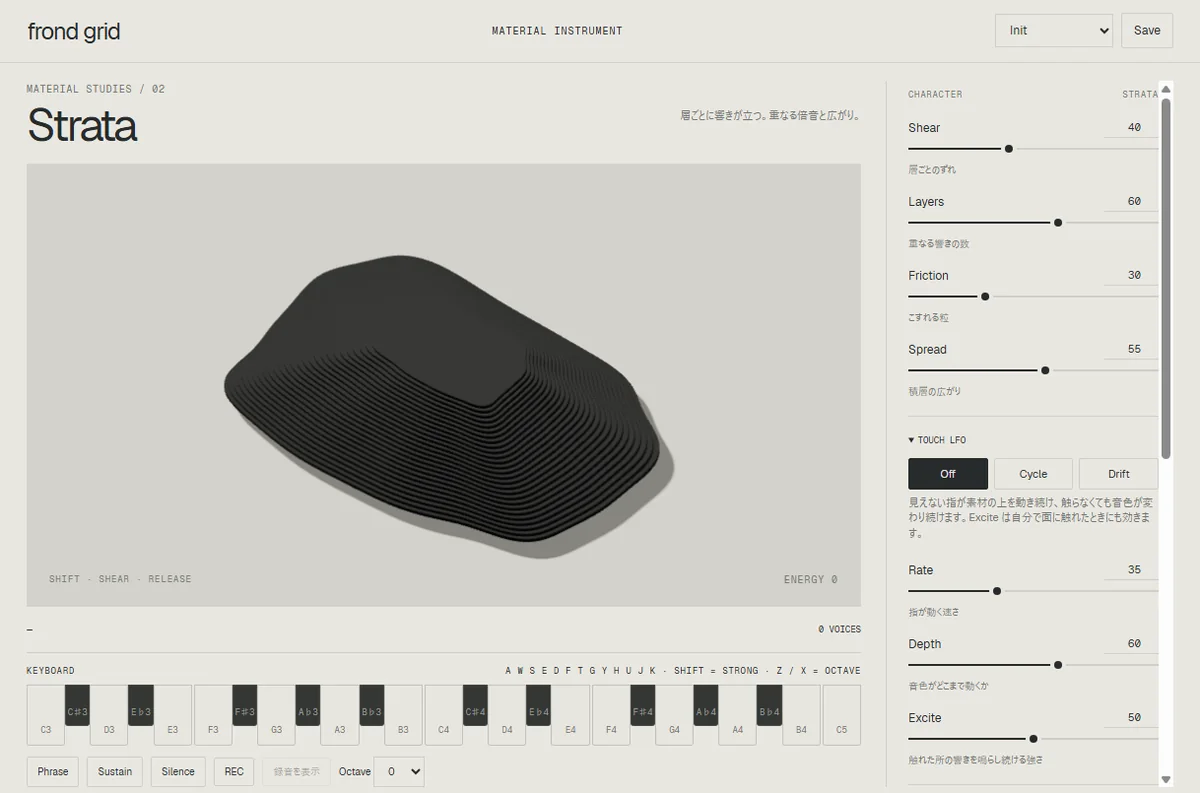
Press and draw on the surface and the sound follows the shape under your finger. Touch LFO keeps an unseen finger moving over the material, in a loop (Cycle) or wandering (Drift), so held notes keep changing colour on their own. Excite sets how strongly a touch keeps the material ringing: a rubbed membrane, a single layer waking up, scattered grains, glints on ceramic, breath in a reed.
Six characters, one way of playing
Tension is a struck membrane, Strata a stack of ringing layers, Mineral a dry strike on stone, Reed a breathy sustained tone, Facet a bright ceramic strike, Fold a soft tone woven from even and odd overtones. All six share the same controls for envelope, space and play.
In tune by design
Touch, velocity and the material controls change the timbre only. Pitch moves only with pitch bend and Transpose, so chords sound clean on every instrument.
Play the surface
Press and draw on the material surface to play; the picture moves with the sound. Or use the on-screen keyboard, your computer keyboard, or a MIDI keyboard with velocity, sustain, pitch bend and pressure.
Compare them side by side
The six are level-matched. A MIDI phrase is included so you can play the same five chords through each and choose by ear. Six presets per instrument as starting points.
Play from a MIDI keyboard, record what you play
The mod wheel slides the touching finger across the surface and breath (CC2) moves it front to back, so a keyboard alone can touch the material. REC records what you play to a WAV file you can drag into any project.
How it works
- You bring
A MIDI part or your playing
- It does
Rings it through one of six modelled materials
- You get
An in-tune instrument part with its own character
Screens
Click a screen to see it full size.
Details
- Price
- Pay what you want (from $0, suggested $15)
- Release date
- October 24, 2026
- Systems
- macOS 11+ (Apple silicon) · Windows 10 / 11 (64-bit): VST3 and standalone app
One purchase covers both Mac and Windows. - Formats
- Audio Unit · VST3 · standalone app
- Status
- On sale
Questions
Are these recordings of real objects?
No. Each instrument is a musical model of a material. Nothing is sampled, and the tuning is exact.
Does Touch LFO change the pitch?
No. It moves only the colour of the sound, so chords stay in tune.
Which formats and systems?
Mac: macOS 11 or later on Apple silicon (an Intel build is included but has not been run on an Intel Mac), with Audio Unit, VST3 and a standalone app for each of the six. Windows: 64-bit Windows 10 or 11, VST3 and a standalone app. One purchase covers both.
How many notes can I play at once?
Up to 32 voices per instrument.
What does Motion do?
It sets how strongly the picture reacts to your playing. It does not change the sound.
Can I record what I play?
Yes. REC writes a 24-bit WAV of what the instrument plays to Music/Frond Grid/Six Materials Takes.
 CUT
 MOSAIC
 SPRIG
 WEFT
 BUBBLE STUDIO
 ODD PARTS
 FIELD
 RELAY
 COLONY